
The attuned enough parent
Parenting books often talk up the need for 'attunement' with our kids. But what does that actually mean, and can we do it deliberately?


When our daughter was a baby, she’d get what Jessie and I called ‘The Excitement’. Her arms and legs would start wiggling, her eyes would widen with delight and the most amazing, high-pitched coo would come out of her mouth. We could never say for sure what caused The Excitement – at least not in the beginning – but often, I’d find myself responding by pumping my fists, like I was celebrating a goal in football. “C’MOOON!” I’d tell Olive, as she smiled back at me, “EXCIIIITMEEENT!”.
At the time I thought this was just sleep-deprived delirium. But reading over the work of Daniel Stern, the American psychoanalyst who in the 1970s transformed our understanding of how babies experience relationships, I realise it may have been something else – something vital for the development of our bond, and Olive’s development. What was happening was attunement.

Three decades prior, Donald Winnicott had coined perhaps the most reassuring phrase in all of child psychology: the “good-enough mother” (adapted today to the “good-enough parent”). It’s the idea that we don’t need to be perfect caregivers, we just need to get things right a decent chunk of the time in order for our kids to turn out fine (30% according to later researchers).
But good enough at what, exactly? Since Olive was born, I’ve been preoccupied with that question. No matter who you read on the subject of child development, it tends to come back to the same answer.
What is ‘attunement’ when it comes to children?
Attunement is one of those words you encounter a lot if you do therapy. Before becoming a father, I spent 8 years with a psychoanalyst trying to figure out how to attune to myself. I’d reached my early 30s with a very distorted view of my own emotions – hyper alert to some, in complete denial of others – which was causing all kinds of problems. Now, I have a new motivation to try and be as self-attuned as I can: modelling it for Olive. But even if I succeed (enough) at that, how do I attune to her?
Stern gave ‘attunement’ its specific use within parenting psychology, which can be summarised as:
the capacity to perceive, understand and respond to our child’s inner experience.
On one level, this sounds like parenting 101. We perceive our babies are hungry, stressed or tired, and feed, comfort or put them down to nap in response. But Stern talked about a different and more subtle form: affect attunement. Affect attunement is understanding what our child is feeling then matching the emotional quality, or vitality of it, often through a different type of behaviour (what he called cross-modal matching). This is effective because it plays uniquely into how babies and toddlers understand the world.
For example: imagine your baby points up at an aeroplane and shouts. They haven’t seen an aeroplane before, and the sight of something flying through the sky is amazing to them. You could ignore them, you could divert their attention to something else, or you could do what we often do with babies when we’re distracted, which is reflexively imitate them by making the same sound. A fourth option would be to pick up on their amazement by saying something like “Wow!” and looking up too. This is affect attunement: reflecting our child’s inner experience in a way that makes them feel understood.

Stern argued that babies and toddlers experience life as a flow of energy and feeling. They can’t intellectualise anything yet. Attuned parents are able to match and ride those flows. When a baby’s excitement crescendos, they respond with a rising voice (or maybe a weird football match fist pump). When a baby freezes in uncertainty, they become still and watchful. When a baby’s energy dips after experiencing frustration, the parent slows and softens.
Stern’s most influential insight was that this sort of thing – which we often do instinctively – matters far more than we might think. He believed babies are more socially aware and emotionally sophisticated than previously assumed, and that parent-child relationships are built through thousands of these tiny moments of shared attention – not just through feeding, play and meeting physical needs.
Attunement isn’t the same as ‘validating feelings’
Stern’s theory of attunement is not quite the same thing as ‘validating feelings’, that tenet of Gentle Parenting that requires crouching down in front of your toddler and saying earnest stuff like: “I understand you are angry that your beaker is orange instead of red.” The truth is that babies and toddlers can’t process emotions in that way yet – conceptually – which is why all those Big Feelings conversations seem to go in one ear and out the next. But little kids do have a remarkable ability to recognise the emotional quality in different kinds of expressions, something Stern called vitality affects (Winnicott put this beautifully when he suggested that a baby first sees itself in its mother’s face).

For the parenting chapter of my book, I interviewed a child psychologist called Dr. Naomi Fisher. I was anxious to know, ahead of Olive becoming a toddler, how best to deal with tantrums and outbursts of anger. The advice that really stuck with me was when she recommended parents try and “meet the energy” of our children in those difficult moments. So rather than say “I understand you are frustrated” in some serene therapist-voice (which is only likely to infuriate them further), we find some way to briefly share in the frustration, be that with a look or a tone of voice (the trick is doing that without condoning any bad behaviour they may be exhibiting). This comes back to Stern’s claim that children don’t merely need to be ‘seen’, they need to feel that their experience has been understood.
Trying to attune ‘on purpose’
Sometimes, when Olive cries, I remember I am supposed to be ‘attuning’ and find myself doing some sort of bizarre ‘sad clown’ face. I am sure this must seem sarcastic, even to her 18-month-old brain. Trying to attune on purpose tends to make us theatrical rather than authentic; it’s also not something Stern recommended (he was a researcher, not a parenting guru).
I’ve thought a lot about this, and I think the best – perhaps only – way to cultivate attunement with your child is not to think too deeply about yourself at all, but to try and cultivate an ever deeper curiosity about them. Instead of asking yourself ‘what are they doing right now?’, something more like ‘what are they experiencing?’ If there’s a practical lesson to take away from Stern – who spent thousands of hours watching babies and parents – it is probably that attunement is a byproduct of paying attention.
Another mistake I often make is to try and gee Olive up to whatever mood I am in (if it’s a positive one – I’ve no interest in bringing her down!). Generally speaking, seeing her gives me The Excitement, usually because I’ve been at work, and the best hour of my day is the one I have with her before she goes to bed. Sometimes, though, my little girl is quiet and thoughtful or just too tired for my nonsense. So I try to remind myself, in those moments, that it’s better to be calm and present, to just let her be. There can be a silent pressure as a parent – which gets worse depending on your personality type – to be upbeat and entertaining all the time. But that’s an annoying energy to be mismatched with as an adult. Why would it be any different for a toddler?
Another phrase Stern coined was ‘moments of meeting’. It describes a highly authentic connection between two people that might only last a few seconds: the pinnacle, in a sense, of ‘attunement’. These moments don’t come along that easily or often with anyone, adult or child. His message – a bit like Winnicott – was not to expect perfection from yourself, just to try and create the conditions where the magic can happen.
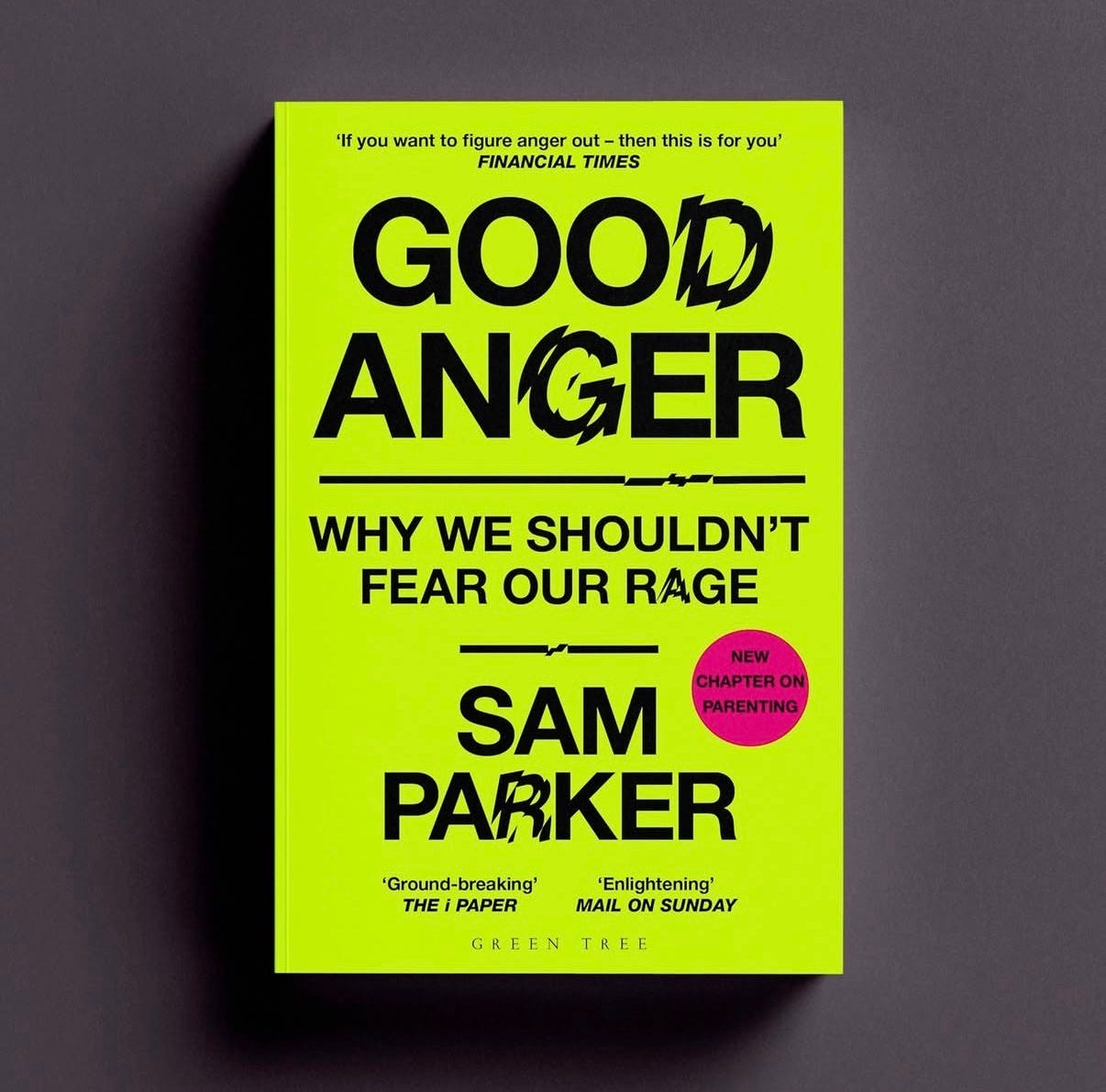
My book is out in paperback! It’s called Good Anger: Why We Shouldn’t Fear Our Rage and it’s a blend of psychology, history and memoir about how embracing a taboo emotion can help people pleasers, conflict avoiders and anyone suffering with anxiety.
There is also a new chapter on parenting I think you’ll love.
Good Anger was named a book of the year by The Independent, GQ, Glamour, Esquire and The Next Big Idea Club and featured in the Guardian, Observer, Sunday Times, Mail on Sunday and more.
It can be ordered online at Amazon or Waterstones.
Had never heard of attunement, but glad to have now. I do think even very young kids are more tuned into falseness than we think—they can tell when you’re faking it! So it’s gotta be real!
The woman who is the true authority on infant observation is Beatrice Beebe. There are real developmental and emotional consequences when parents frequently misattribute emotions as a consequence of their unrecognised projections e.g. „stop being grumpy“ when a child is sad etc., but by the time language can even be understood the vast majority of the damage is done. If the „still face experiment“ taught us anything, it is that nonverbal communication in the form of timely and accurate attunement matters. Of course we can go over the top with this and Winnicott‘s „good enough“ is helpful here, but if one only gets it right 20% of the time then that’s clearly not good enough.